Artificial Intelligence & Data (keep it safe)
How ReportBurster safely leverages AI to help you analyze data, build, automate, and distribute reports — while keeping your data private.
Table of Contents
- Few Notes on AI Usage within ReportBurster & Data Privacy
- Recommended AI Models
- Verify It Yourself — The Code Is Open Source
ReportBurster leverages AI to help you explore your databases in natural language, generate SQL queries and reports, design data models and ER diagrams, create dashboard mockups, and get expert guidance on configuration — we provide a built-in team of AI advisors that understand ReportBurster and your data.
This page explains how we keep your data safe while doing it.
Few Notes on AI Usage within ReportBurster & Data Privacy
Shorter Version: Your data remains yours, your actual data never leaves your systems.
AI Usage Is Fully Optional
From the very beginning, we architected ReportBurster to make AI usage fully optional. We understand that there will always be legitimate reasons for some organizations to have zero tolerance for using AI over critical data — and because of that, ReportBurster delivers most of its value without any AI at all.
You can configure database connections, explore schemas, generate reports, and distribute documents entirely without any AI usage — and still get significant value from the tool.
Use AI During Development, Disable It in Production
You can use AI only during development time — while you develop, configure, and test your reports — and then completely disable everything related to AI in production.
This way you reap all the AI benefits without worrying that your production data could leak into AI.
Many AI Features Work Without Any Account or API Key
Throughout the application and documentation, you will see buttons like

When you click one, ReportBurster prepares a prompt containing only structural metadata — table names, column names, keys, and schema information. It never includes actual data rows. You copy this prompt to any AI chat provider of your choice (OpenAI, Claude, Microsoft Copilot — even without logging in), get the code you need back, and paste it into ReportBurster.
The AI never connects to your database. It never sees your data. It only sees the shape of your tables — enough to generate correct code.
FlowKraft AI Hub (AI Crew)
In the FlowKraft AI Hub settings, you'll need to provide an API key from your preferred AI vendor. This is required to power the AI Crew — the team of AI experts built into ReportBurster: Athena (data & reports), Hephaestus (automation & ETL), Hermes (portal expert), and Apollo (Next.js/React).
The AI Crew was carefully designed to give you all the AI benefits without exposing any of your data. The result feels like magic — you Chat2DB with Athena, she writes SQL queries for you, generates ER diagrams, and helps you analyze your database visually with charts.
Yet Athena — and none of the other AI assistants — has access to any of the actual data she helps you analyze.
During any Chat2DB interaction, what Athena receives is:
- The list of available table names (as a quick index for identifying relevant tables)
- The database schema metadata (tables, columns, keys, indexes)
When you ask a question in natural language, Athena identifies the relevant tables, examines their columns, builds an SQL query, and returns it to ReportBurster. ReportBurster then executes the query against your database and displays the results. Athena handles the conversation and the SQL generation — your database engine handles the execution. The two never interact directly.
This separation of concerns — where Athena generates the SQL and visualizations while your database engine executes them — has very few practical limitations. In fact, most users are never even aware that Athena does not have direct access to their data, because her answers are so accurate and responsive. Some users find it hard to believe even after being told.
For the sake of completeness, when creating or updating AI assistants, ReportBurster includes a "Give db_query tool to Athena" option (OFF by default). In some situations, you may find it beneficial to enable this — but it is entirely your choice.
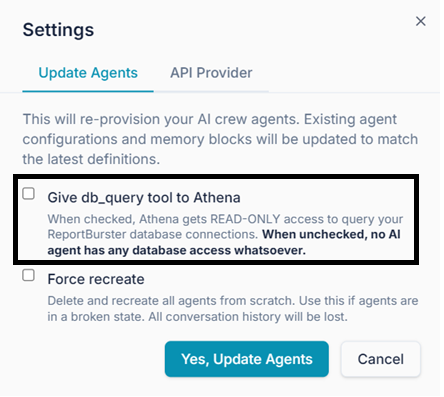
When might this tool help? Occasionally, Athena makes an incorrect assumption about your database — for example, that datetime fields are stored in a particular format — and generates a query that fails. Without the db_query tool, she hands you the query, you run it, see the error, report it back, and she corrects it. With the tool enabled, Athena executes the query herself first, catches the error, and returns the corrected query directly — saving you one round trip. This rarely happens, and when it does, it is easy to resolve either way.
The other AI assistants (Hephaestus, Hermes, Apollo) operate in domains that do not require and do not have any knowledge of your database connections.
Recommended AI Models
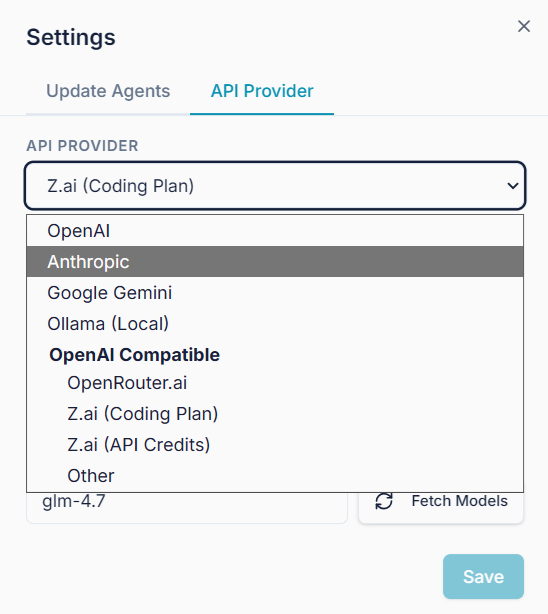
Anthropic's models — Opus and Sonnet — are both excellent choices.
That said, we have had very good results with GLM-4.7, an open-source model by Zhipu AI, available at a fraction of Anthropic's pricing.
Zhipu AI recently released GLM-5, which is receiving strong praise — we have not tested it yet ourselves.
Verify It Yourself — The Code Is Open Source
We are confident in the approach described above. But you do not have to take our word for it — ReportBurster is open source. Browse the full source code at github.com/flowkraft/reportburster and see exactly how every AI interaction is implemented.
Have your security team review the code. If they find a data-privacy bug in the implementation, report it and we will fix it promptly.