ReportBurster vs SSAS + SSIS — The Open-Source Data Warehouse Alternative
Why This Comparison Matters
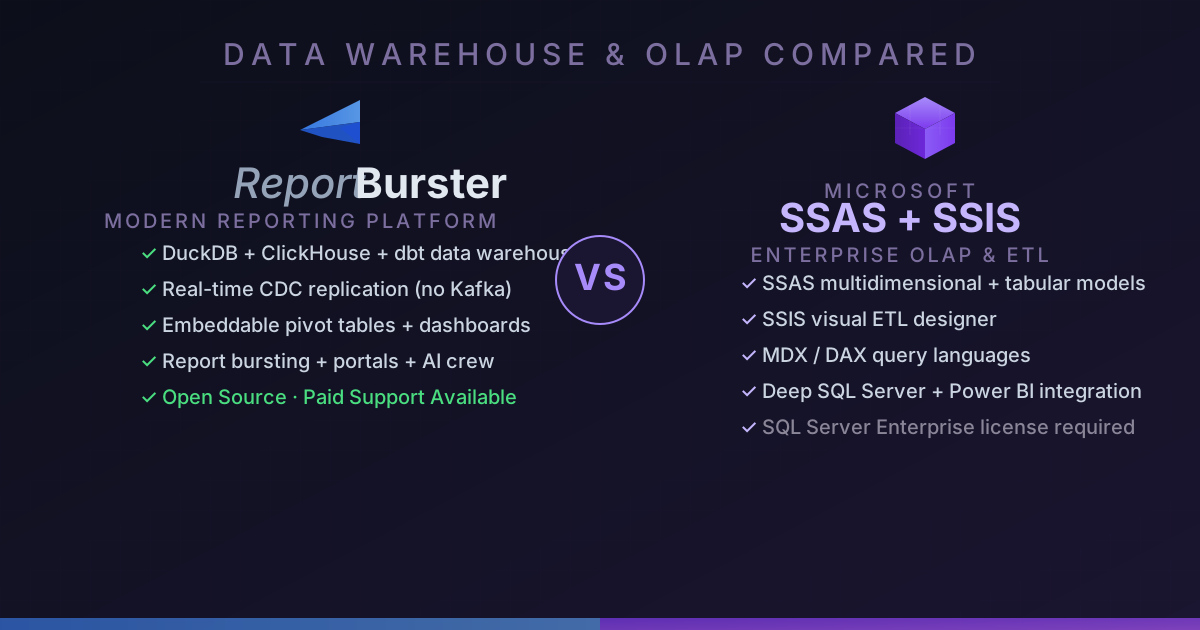
SSAS and SSIS aren't BI platforms — they're infrastructure components. SSAS is an OLAP engine (multidimensional cubes, tabular models, MDX/DAX). SSIS is an ETL tool (visual data flow pipelines, scheduled transforms). Together, they've been the default Microsoft stack for data warehousing and ETL for over 20 years.
Unlike other comparisons on this site, we skip the feature comparison table here. SSAS and SSIS are specialized infrastructure — an OLAP engine and an ETL tool — not full BI platforms. Rating them on report generation, document portals, or AI capabilities would be meaningless. Instead, this page is a free-text deep dive into what matters: the data warehouse layer.
ReportBurster covers also this ground — data warehouse and OLAP — using modern open-source engines: DuckDB for embedded analytics, ClickHouse for enterprise-scale OLAP, dbt for SQL-based transforms, and CDC replication via the Altinity Sink Connector for real-time data sync. No SQL Server Enterprise license. No Windows Server dependency. Cross-platform, open source, and bundled with everything SSAS and SSIS were never designed to do: report generation, automated bursting, document portals, embeddable web components, and AI.
Where ReportBurster Pulls Ahead
Data Warehouse Without the Enterprise Tax
ReportBurster's three-tier OLAP approach scales from quick prototyping to enterprise-grade warehousing:
| Tier | Engine | Data Scale | Best For |
|---|---|---|---|
| Browser | <rb-pivot-table> backed by user's browser | Up to ~100K rows | Quick ad-hoc analysis, no server needed |
| DuckDB | <rb-pivot-table> backed by DuckDB | ~100K – 100M rows | Fast analytical queries, zero administration |
| ClickHouse | <rb-pivot-table> backed by ClickHouse | 100M – 10B+ rows | Enterprise-scale data warehouse |
The same <rb-pivot-table> web component works identically across all three engines — same drag-and-drop interface, same aggregations, same user experience. Start with DuckDB on your laptop. Scale to ClickHouse when you need billions of rows. No code changes.
SSAS requires SQL Server Enterprise licensing ($15,000+ per core), Windows Server, dedicated SSAS instances, and careful memory management for tabular models. Multidimensional cubes need MOLAP processing time. ReportBurster's DuckDB runs embedded with zero administration, and ClickHouse ships pre-configured in Docker Compose — one command to start.
CDC Replication — No SSIS Packages Required
Getting operational data into your warehouse is the first step. ReportBurster uses the Altinity Sink Connector for real-time CDC (Change Data Capture) replication from your OLTP databases directly to ClickHouse.
Supported sources:
- MySQL and PostgreSQL — native, out of the box
- SQL Server, Oracle, Db2, MongoDB — via Debezium connectors
How it works: Enable CDC on your source (binlog for MySQL, WAL for PostgreSQL), edit docker-compose.yml with your connection details, run docker compose up. Changes in your production database appear in ClickHouse within seconds — no batch jobs, no stale data.
With SSIS, the same task requires building ETL packages in Visual Studio's drag-and-drop designer, configuring Control Flow and Data Flow components, deploying to SSISDB, and scheduling via SQL Server Agent. CDC in SQL Server requires explicit per-table setup, and SSIS is fundamentally batch-oriented — not real-time by design. A simple "replicate these tables" task that takes minutes with ReportBurster's CDC connector takes hours or days to build, test, and deploy with SSIS.
dbt for Star Schema Transforms — Modern ETL
CDC gets raw OLTP tables into ClickHouse, but raw tables aren't a data warehouse. ReportBurster bundles dbt Core with the dbt-clickhouse adapter to transform raw data into a proper star schema:
- 5 staging views — thin rename/cast layer over raw OLTP tables
- 4 dimension tables —
dim_customer,dim_product,dim_employee,dim_time - 1 fact table —
fact_sales(~8,000 transactions) - 2 analytical views —
vw_sales_detail,vw_monthly_sales
Running the transform is one command: docker compose run --build dbt-transform run. Docker handles the environment. dbt handles the SQL. Everything is version-controlled, testable, and defined in plain SQL — not XML.
SSIS uses a visual designer with 30+ built-in data transformations (Slowly Changing Dimension, Fuzzy Lookup, Merge Join, etc.). Powerful for complex scenarios, but SSIS packages are XML under the hood, version control requires the SSISDB catalog, and there's no built-in testing framework. dbt's SQL-first approach is simpler to learn, easier to maintain, and integrates naturally with git workflows.
The bundled Northwind models ship as a working template. Replace them with your own business schema and rebuild — the star schema pattern stays the same.
Embeddable Pivot Tables and Web Components
ReportBurster provides framework-agnostic web components — pivot tables, data tables, charts — that you embed in any web app with a script tag. React, Angular, Vue, plain HTML — anything. Plus interactive KPI dashboards for sales performance, financial reporting, and real-time business monitoring.
The <rb-pivot-table> component connects directly to DuckDB or ClickHouse, handles server-side aggregation for large datasets, and provides an interactive drag-and-drop interface with multiple renderers (table, heatmap, bar chart).
SSAS provides ADOMD.NET for .NET applications and XMLA endpoints for programmatic access — but no embeddable web components. To visualize SSAS data in a web app, you typically need Power BI (a separate product with its own licensing) or Excel PivotTables. There's no equivalent to dropping a <script> tag into your existing web app and getting an interactive pivot table connected to your OLAP engine.
The Full Platform — Bursting, Portals, AI
This is the fundamental difference. SSAS and SSIS are infrastructure components — they handle OLAP and ETL but nothing else. You still need separate tools for report generation, distribution, and end-user delivery.
ReportBurster is a complete platform. Beyond the data warehouse, you get:
- Report bursting — split by any key(s), deliver via email, FTP, cloud storage, or web portal, with built-in quality assurance
- Document portal — per-user access where each person sees only their own documents (payslips, invoices, statements), with notifications and online payments
- AI crew — specialized agents (Athena for data warehouse design, Hephaestus for automation, Hermes for portals, Apollo for web components) powered by Claude, GPT, or Gemini
- Chat2DB — conversational data exploration with natural language SQL generation
Athena, in particular, has knowledge of the entire OLAP stack — she can guide you through CDC replication setup, dbt star schema design, pivot table configuration, and ClickHouse tuning in a real AI conversation.
Cross-Platform and Open Source
ReportBurster runs on Windows, Linux, and macOS. DuckDB and ClickHouse are cross-platform. dbt is Python-based. The entire stack is open source with no per-core licensing.
SSAS and SSIS run on Windows Server only. SQL Server Enterprise licensing is per-core (thousands of dollars per core). Azure Analysis Services charges by QPU-hour. For organizations wanting to avoid vendor lock-in and enterprise licensing costs, ReportBurster's open-source stack is a fundamentally different economic model.
Where SSAS + SSIS Still Hold Up
SSAS Multidimensional — 20 Years of OLAP Maturity
SSAS Multidimensional has been refined since 2000. MDX query language, MOLAP/HOLAP/ROLAP storage modes, calculated members, named sets, writeback, KPIs, perspectives, translations — it's an extraordinarily deep OLAP engine. For organizations with hundreds of existing cubes and thousands of MDX queries, that represents years of invested work.
SSAS Tabular (the newer model) adds DAX, in-memory xVelocity compression, and DirectQuery for real-time pass-through. Power BI's live connection to SSAS Tabular is seamless — no data duplication, no import latency.
SSIS — The Industrial ETL Workhorse
SSIS has 30+ built-in data transformations: Slowly Changing Dimension, Fuzzy Lookup, Fuzzy Grouping, Data Conversion, Merge Join, Conditional Split, and more. The visual designer provides breakpoint debugging, data viewers mid-pipeline, and event handlers for error routing. For complex ETL scenarios involving 100+ heterogeneous sources, custom business logic, and elaborate error handling, SSIS has a depth of transformation components that dbt's SQL-only approach cannot match.
The Microsoft Ecosystem
If your organization runs SQL Server + Active Directory + Power BI + Azure, SSAS and SSIS slot in without introducing new vendors. Same installer, same security model, same SSMS management console, same monitoring (SQL Server Profiler, Extended Events). Power BI's live connection to SSAS Tabular is native and seamless. For IT teams standardized on the Microsoft stack, that operational simplicity has real value.
The Bottom Line
Choose ReportBurster when you want an open-source data warehouse stack — DuckDB for embedded analytics, ClickHouse for enterprise-scale OLAP, real-time CDC replication, dbt for SQL-based transforms — bundled with report generation, automated bursting, document portals, embeddable web components, interactive dashboards, and AI. Cross-platform, no SQL Server Enterprise license, no per-core fees.
Choose SSAS + SSIS when your organization is deeply invested in the Microsoft SQL Server ecosystem, you have existing SSAS cubes with MDX queries and SSIS packages in production, and the Windows Server + SQL Server Enterprise licensing model fits your procurement process.
For teams starting fresh with data warehouse and OLAP requirements, ReportBurster offers a modern, open-source path that covers more of the BI lifecycle in a single platform — from raw data ingestion to interactive dashboards to end-user document delivery.