ReportBurster vs IBM Cognos Analytics — Modern BI Meets Enterprise Legacy
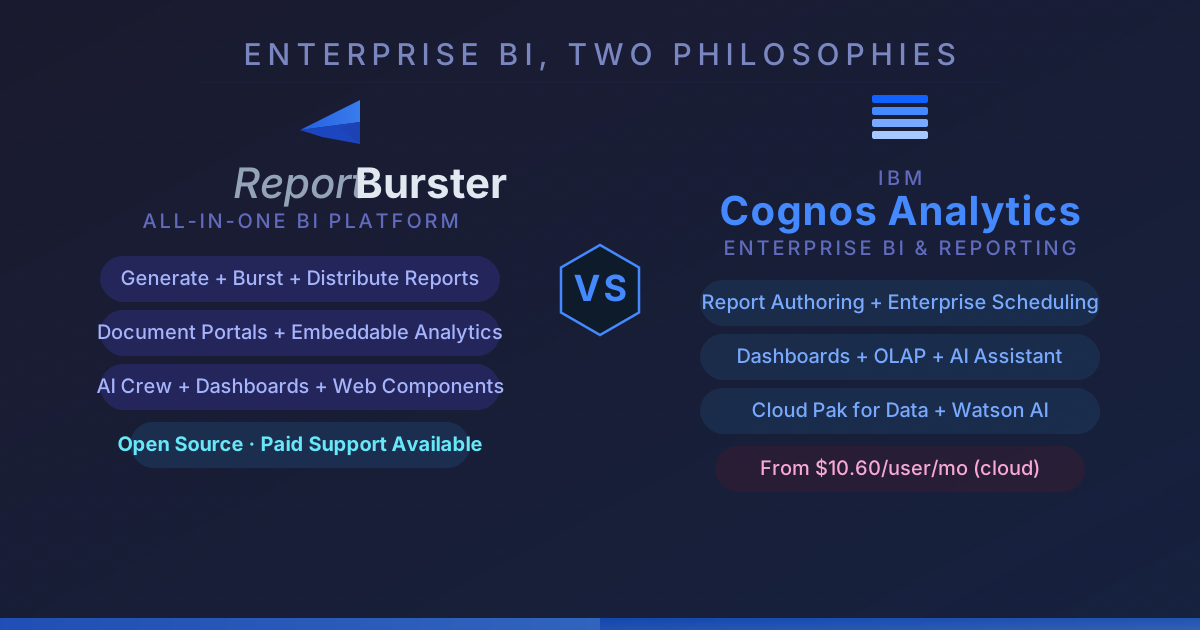
Two Eras of Enterprise BI
ReportBurster is a single platform where you connect to your data, generate formatted documents, split and deliver them automatically, give end-users a portal with just their own files, and embed interactive analytics into your own web apps — all open source, all self-hosted.
IBM Cognos Analytics is one of the longest-running names in business intelligence. It grew up in the boardrooms of Fortune 500 companies — report authoring, scheduled distribution, OLAP analysis, and tightly governed metadata layers. It does these things with the polish of a product that's had decades of enterprise deployments behind it.
The Full Comparison
| Capability | ReportBurster | IBM Cognos Analytics |
|---|---|---|
| Data Exploration | ||
| SQL Database Connectivity | ★★★★★ Broad JDBC connectivity | ★★★★★ Broad JDBC/ODBC connectivity — DB2, Oracle, SQL Server, PostgreSQL, Teradata |
| NoSQL Databases | ★★☆☆☆ Redis for now, more will come (if community asks) | ★★☆☆☆ Limited — primarily relational databases |
| CSV / Excel Files | ★★★★★ | ★★★★☆ Excel and CSV upload as data sources |
| Natural Language Queries | ★★★★☆ Built-in Chat2DB for conversational data exploration | ★★★★☆ AI Assistant with natural language exploration (Cognos Analytics 12+) |
| Database Management & Editing | ★★★★☆ Via CloudBeaver and built-in Chat2DB web app | ★★★☆☆ Framework Manager for metadata modeling; data modules for self-service |
| Report Generation | ||
| PDF Report Generation | ★★★★★ | ★★★★★ Enterprise-grade paginated PDF report generation |
| Excel Report Generation | ★★★★★ | ★★★★★ Formatted Excel export with structure preservation |
| HTML / Word Report Generation | ★★★★★ HTML and Word documents | ★★★★☆ HTML and active reports (offline interactive HTML) |
| Template / Report Designer | ★★★★☆ AI-assisted templating | ★★★★★ Report Authoring (formerly Report Studio) — pixel-perfect enterprise reports |
| Parameterized Reports | ★★★★★ Full parameter support with variables and templating | ★★★★★ Prompts, cascading parameters, drill-through |
| Data Source Variety | ★★★★★ SQL, Excel, CSV, XML data sources | ★★★★★ SQL, OLAP cubes, Framework Manager models, Excel, CSV, REST data sources |
| AI-Assisted Report Building | ★★★★☆ AI crew (Athena) for report generation using LLMs | ★★☆☆☆ AI Assistant suggests visualizations; no full AI report generation |
| Report Distribution & Automation | ||
| PDF Bursting / Splitting | ★★★★★ Industry-leading split and distribute by any key(s), one or two levels | ★★★★☆ Report bursting via scheduled jobs — split by parameter values and distribute per recipient |
| Report Archiving | ★★★★★ Flexible archiving with dynamic folder structures and variables | ★★★★☆ Report output versioning and saved report views in Content Store |
| Email Distribution | ★★★★★ | ★★★★☆ Scheduled email delivery of reports |
| FTP / SFTP Upload | ★★★★★ | ★★★☆☆ File system output; FTP via custom scripts or third-party tools |
| Cloud Storage (S3/Azure/GCS) | ★★★★☆ | ★★☆☆☆ Limited native cloud storage; primarily on-premise or IBM Cloud |
| Web Upload | ★★★★★ HTTP/WebDAV and REST APIs (SharePoint, WordPress, Drupal, any CMS) | ★★☆☆☆ Content Store-based management; not flexible web upload |
| Scheduling / Automation | ★★★★★ | ★★★★★ Mature enterprise scheduling with dependencies, calendars, event triggers |
| Delivery Quality Assurance | ★★★★★ Built-in QA guarantees delivery accuracy | ★★☆☆☆ Job history and audit logging |
| Document Portal | ||
| Self-Service Document Portal | ★★★★★ Purpose-built portals for HR payslips, customer invoices, billing with online payments | ★☆☆☆☆ Cognos Connection/Portal for browsing reports — NOT a personalized document portal (no payslip/invoice portals, no online payments) |
| User Management & Access Control | ★★★★☆ Per-user accounts — each user sees only their own documents | N/A Enterprise LDAP/AD permissions for reports, not per-user document isolation |
| Notifications & Alerts | ★★★★☆ Notify users when new documents are available | ★★☆☆☆ Report scheduling notifications and alerts |
| Portal Customization / Dev Stacks | ★★★★★ Grails or Next.js 15/React/Tailwind stacks | ★★☆☆☆ Cognos Portal customization — limited compared to modern web stacks |
| Embeddable Analytics & OLAP | ||
| Interactive Dashboards | ★★★★☆ KPI dashboards for sales, finance, monitoring | ★★★★☆ Interactive dashboards with drag-and-drop; Data Modules for self-service |
| Embeddable Web Components | ★★★★★ Data-driven web components: rb-tabulator, rb-chart, rb-pivot-table | ★★★☆☆ Cognos Dashboard Embedded (separate product) for embedding in custom apps |
| Chart Type Variety | ★★★★★ | ★★★★☆ Good variety of visualization types including maps |
| Pivot Tables / OLAP Views | ★★★★☆ | ★★★★☆ Analysis Studio for OLAP pivot/crosstab; PowerPlay cubes |
| Interactive Data Tables | ★★★★★ rb-tabulator with 50+ configuration examples | ★★★★☆ List and crosstab reports with interactive drill-down |
| Data Warehouse / OLAP Engine | ★★★★☆ OLTP-to-OLAP sync via CDC — DuckDB (up to 100M rows), ClickHouse (billion-row analytics), dbt | ★★★★☆ Framework Manager for modeling; connects to OLAP cubes, DB2 Warehouse, Netezza |
| Real-Time / Performance | ★★★★☆ Redis support for caching and real-time streaming | ★★★☆☆ Live connections; Active Reports for offline interactivity |
| AI Capabilities | ||
| AI Data Analysis | ★★★★☆ Chat2DB: Chat2SQL, tabular data, diagrams, charts | ★★★☆☆ AI-powered pattern detection, forecasting, and anomaly detection |
| LLM Integration (GPT/Claude/Gemini) | ★★★★★ Claude, GPT, Gemini or any other AI vendor | ★★☆☆☆ Watson/watsonx integration; NL query assistant |
| AI Domain Experts / Agents | ★★★★★ Athena (data), Hephaestus (automation), Hermes (portals), Apollo (web) | — |
| Deployment & Hosting | ||
| Self-Hosted / On-Premise | ★★★★★ | ★★★★★ Traditional on-premise deployment; Cognos Analytics on-premise |
| Cloud / SaaS | — | ★★★★☆ IBM Cloud (SaaS); also available on Cloud Pak for Data |
| Docker / Container Support | ★★★★☆ | ★★★☆☆ Certified containers via Cloud Pak for Data |
| OS Support | ✅ Windows ✅ Linux ✅ macOS | ✅ Windows ✅ Linux (RHEL, SUSE) ✅ AIX |
| Integration & APIs | ||
| REST API | ★★★★☆ | ★★★★☆ REST API for administration, content management, and report execution |
| CLI / Scripting | ★★★★★ | ★★★☆☆ Command-line tools, batch scripts, SDK |
| Extensibility / Plugins | ★★★★★ Groovy/Java scripting and 'Works Well With' integrated apps (CloudBeaver, Rundeck, DocuSeal, etc.) | ★★★★☆ Java SDK, .NET SDK, JavaScript API for embedding, custom authentication |
| Documentation & Community | ||
| Documentation Quality | ★★★★☆ Comprehensive docs site with interactive examples | ★★★★☆ IBM Knowledge Center/Docs — comprehensive but sometimes dense |
| Community Size | ★★☆☆☆ New project — growing open-source community (smaller than legacy tools) | ★★★★☆ Large enterprise community, IBM TechXchange, Stack Overflow, many IBM partners and consultants |
| Pricing & Licensing | ||
| Free Tier Available | ★★★★★ Fully functional open-source edition | ★☆☆☆☆ 30-day trial only |
| Open Source | ★★★★★ GitHub — open source | — |
| Pricing Model | Free open source, 🔶 fully functional, no limitations 🔶 — just no professional support) Or, if you need ✅ professional support ✅ License $595–$2,595 (1–10 users) Maintenance $199–$699/yr (1–10 users) | Cloud On-Demand (SaaS): Standard: ~$10.60/user/month (dashboards, mobile, email reports, forecasting) Premium: ~$42.40/user/month (+ enterprise reporting, data exploration, custom roles) On-Premise (Client-Hosted): PVU-based licensing — cost depends on server cores × PVU rating Typical: $5,000–$15,000+ per server core (varies by processor) + 20% annual Software Subscription & Support (~$1,000–$3,000/core/yr) Cloud Pak for Data (containerized): Per Virtual Processor Core (VPC) — custom enterprise pricing Bundled with other IBM data/AI products If you need planning/budgeting → IBM Planning Analytics (TM1), separate product If you need data integration → IBM DataStage, separate product Typical 50-user on-premise: $80k–$200k+ (licenses + maintenance + infrastructure) |
Where ReportBurster Pulls Ahead
Report Bursting That Works Out of the Box
ReportBurster makes bursting its core feature: take any report, split by any key or combination of keys, and deliver via email, FTP/SFTP, cloud storage, HTTP, or a self-service portal — with built-in quality assurance that confirms every delivery. Cognos can burst reports through scheduled jobs — split by parameter values and email each piece to a distribution list — but configuring it involves Framework Manager packages, report prompts tied to burst keys, and careful setup in Cognos Administration.
Self-Service Document Portals
ReportBurster's Document Portal is purpose-built for per-user document delivery: HR generates payslips and each employee logs in to download theirs. Finance publishes invoices and each customer sees only their own — with notifications when new documents land and online payment processing built in. Cognos Connection (the portal UI) lets users browse a report catalog filtered by permissions, but that's report access — it was never designed for this kind of personalized document delivery.
AI Agents Across the Whole Platform
ReportBurster's AI crew (Athena, Hephaestus, Hermes, Apollo) are specialized agents that work across every layer: data exploration via built-in Chat2DB, report generation, distribution configuration, portal setup, and web development. Cognos Analytics 12+ added an AI Assistant that helps with natural language exploration and suggests visualizations — useful within the Cognos world, but limited to that single domain.
Embeddable Analytics — Web Components You Own
ReportBurster provides framework-agnostic web components — data tables, charts, and pivot tables — that drop into any web app with a script tag. No separate product, no additional license. Cognos Dashboard Embedded exists as a separate IBM product for embedding analytics into custom applications, with its own licensing and integration requirements.
The Price Gap
This is where the comparison gets stark. ReportBurster is open source with full functionality — no feature gating, no artificial limits. Paid professional support is available.
IBM Cognos pricing has multiple dimensions:
- Cloud SaaS: Standard at ~$10.60/user/month (dashboards, mobile, basic reporting) or Premium at ~$42.40/user/month (enterprise reporting, data exploration, custom roles). A 50-user Premium deployment costs ~$25,440/year.
- On-premise: PVU-based server licensing — typically $5,000–$15,000+ per processor core depending on your hardware, plus 20% annual maintenance ($1,000–$3,000/core/year). A mid-size deployment with 4 cores easily hits $60,000–$80,000 upfront plus $12,000–$16,000/year in maintenance.
- Cloud Pak for Data: Per Virtual Processor Core pricing, bundled with other IBM data products. Enterprise negotiation only.
And that's before you factor in the additional IBM products that many Cognos deployments require: Planning Analytics (TM1) for budgeting, DataStage for data integration, or Db2 Warehouse for analytical storage — each with its own licensing.
Where IBM Cognos Holds Its Ground
Report Authoring — Built for the Enterprise
Cognos Report Authoring (formerly Report Studio) is one of the most capable enterprise report designers available. Complex layouts, nested data containers, conditional formatting, multi-query reports with master-detail relationships — it handles reporting requirements that would challenge most tools. Decades of refinement show in the depth of its formatting and layout control.
Framework Manager — The Governed Metadata Layer
Framework Manager is IBM's answer to the governance question: define your data model, business rules, dimensional hierarchies, and security filters once. Every report, dashboard, and analysis built on top of that model inherits the same definitions. For large organizations where "one version of the truth" is non-negotiable, this layer provides the control that IT departments demand.
Enterprise Scheduling That Scales
Cognos scheduling handles complex enterprise scenarios: event-based triggers, calendar-aware scheduling, job dependencies, credential management for multiple data sources, and detailed execution history. When you have thousands of reports running nightly across dozens of data sources, this kind of industrial-grade scheduling matters.
The IBM Ecosystem
For organizations already on IBM infrastructure — Db2, DataStage, Cloud Pak for Data, Watson — Cognos fits naturally. Shared authentication, common management consoles, and native data source connections reduce the integration overhead that comes with introducing a new vendor.
Active Reports — Offline Interactive Documents
A genuinely unique capability: Active Reports are standalone HTML files that users can download and interact with offline — filter, sort, drill — without any server connection. For field teams, executives on planes, or environments with unreliable connectivity, it's a feature nobody else offers in quite the same way.
The Bottom Line
Choose ReportBurster if you want one platform covering report generation, automated bursting and distribution, self-service document portals, embeddable analytics, interactive dashboards, and AI — open source, self-hosted, without enterprise licensing complexity or per-core server fees.
Choose IBM Cognos if you're already embedded in the IBM ecosystem, your organization needs Framework Manager's governed metadata layer, and the enterprise licensing model (cloud starting at ~$10.60/user/month, on-premise via PVU server licensing) fits your procurement process.